 Report
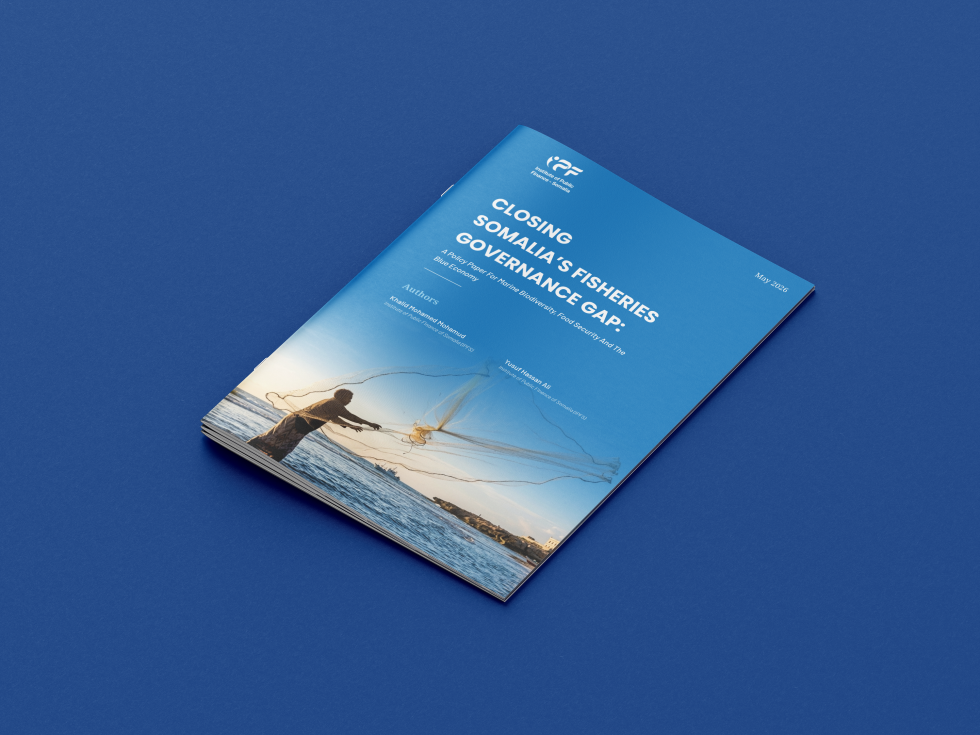
Closing Somalia’s Fisheries Governance Gap: A Policy Paper for Marine Biodiversity, Food Security and the Blue Economy
The report, authored by Khalid Mohamed Mohamud and Yusuf Hassan Ali from the Institute of Public Finance of Somalia (IPFS), argues that Somalia’s fisheries crisis is not simply about overfishing or illegal foreign vessels. Instead, the deeper problem is a governance gap: Somalia has vast marine resources, but lacks the institutions, infrastructure, monitoring systems, and policy implementation needed to convert those resources into sustainable national welfare. The paper presents fisheries governance as a critical issue connected not only to marine conservation, but also to food security, employment, public revenue, state-building, coastal stability, and the development of Somalia’s blue economy. Main Argument of the Report Somalia possesses one of the largest marine domains in Africa: Coastline: approximately 3,333 km Exclusive Economic Zone (EEZ): more than 1.07 million km² Estimated sustainable fisheries potential: over 200,000 metric tons annually Despite this enormous resource base, Somalia captures very little domestic benefit from fisheries. The report argues that: Fish stocks are poorly monitored. Illegal, unreported, and unregulated (IUU) fishing remains widespread. Infrastructure such as cold chains, ports, storage, transport, and processing facilities is underdeveloped. Licensing systems are inconsistent and weakly enforced. Fisheries data systems and registries are incomplete. Domestic value addition is extremely limited. As a result, Somalia loses large amounts of potential income, employment, food access, and public revenue. Key Findings 1. Huge Gap Between Resource Potential and Actual Domestic Catch The report identifies a major mismatch between Somalia’s marine potential and current harvest levels. Although Somalia could sustainably harvest well over 200,000 metric tons annually, documented catches in 2022 were only around: 6,000 metric tons by artisanal fishers 13,000 metric tons by industrial foreign fleets Total documented catch: roughly 19,000 metric tons The report stresses that this does not mean Somalia should immediately increase fishing intensity. Instead, it shows that Somalia lacks the governance systems required to properly manage and benefit from its fisheries resources. The authors argue that low domestic catch can coexist with high external extraction because much fishing activity occurs beyond effective Somali monitoring and regulation. 2. Somalia Faces a Food Security and Nutrition Paradox Despite abundant marine resources, fish consumption in Somalia remains extremely low. The report notes: Somalia’s per capita fish consumption: 3.3 kg African average: 9.1 kg Global average: 20.7 kg The report explains that this is not simply due to cultural preference. Instead, it reflects: Weak cold-chain systems Poor transportation Limited fish processing Weak domestic market integration High inland distribution costs As a result, coastal fish harvests fail to translate into broad national nutritional improvements. The paper emphasizes that fisheries policy should therefore also be treated as food-system policy. 3. Massive Economic Leakage Through IUU Fishing and Weak Governance One of the report’s strongest findings concerns the loss of fisheries value to foreign actors. According to cited estimates: Somalia’s domestic fisheries sector value: about US$135 million Estimated value captured externally through IUU fishing: about US$306 million The report argues that Somalia’s problem is not only low production, but also weak control over access to its marine resources. The paper identifies several causes of value leakage: Unlicensed or weakly monitored fishing Opaque access agreements Weak inspection systems Limited domestic processing Poor tax and fee collection Lack of traceability systems The authors argue that fisheries rents are largely captured outside formal Somali institutions, weakening both public finances and incentives for domestic investment. 4. Fisheries Governance is Linked to Security and Stability The report highlights how fisheries governance intersects with coastal security and piracy. Weak governance, unequal distribution of marine benefits, and IUU fishing can contribute to grievances and instability in coastal communities. The paper argues that fisheries governance should therefore be seen as part of Somalia’s broader state-building and stabilization agenda. 5. Somalia Has Improved Policies, But Weak Implementation The report recognizes significant policy progress in recent years: Federal Fisheries Law adopted in 2023 Somalia Fisheries Master Plan endorsed in 2024 Launch of the Badmaal fisheries project Biodiversity conservation initiatives launched in 2026 However, implementation remains weak. By April 2025: Only 2 fisheries management plans had been developed out of a target of 20. Fisheries registries remained largely non-operational. Patrol days were still recorded at zero. Climate-resilient fisheries infrastructure was not yet operational. Scientific stock assessments were absent. The report concludes that Somalia currently has “more policy architecture than implementation depth.” The Governance Gap Framework The authors define Somalia’s fisheries governance gap as the distance between: what Somalia’s marine resources could generate under proper management, and what the country currently captures in terms of food, jobs, public revenue, biodiversity protection, and sustainable economic development. The report identifies four interconnected deficits: Weak knowledge of fishing effort and stock conditions Low domestic value capture Weak integration of fisheries into food systems Limited state capacity for enforcement and coordination Major Policy Recommendations The report strongly argues against jumping immediately to advanced quota systems or complex fisheries markets. Instead, it proposes a phased and realistic reform strategy. Phase 1: Build a Minimum Viable Governance System The report recommends immediate priorities such as: Digital registries for fishers, vessels, and licenses Public disclosure of offshore fishing licenses Standardized landing-site logbooks Risk-based monitoring and surveillance systems The authors argue that these foundational systems are more important than advanced reforms at Somalia’s current stage. Phase 2: Invest in Infrastructure The report recommends investments in: Landing sites Ice production Cold storage Hygienic handling systems Transportation infrastructure Infrastructure is presented not only as an economic investment, but also as a governance tool because it improves inspection, monitoring, traceability, and enforcement. Phase 3: Protect Artisanal Fisheries and Expand Co-Management The report recommends: Legally protected inshore artisanal fishing zones Restrictions on industrial vessel encroachment Community-based co-management systems Greater participation of women in fisheries governance The authors argue that centralized government control alone is unlikely to succeed in Somalia’s context. Phase 4: Introduce Traceability and Certification Once basic monitoring systems exist, Somalia can begin implementing: Verified legal sourcing systems Traceability programs Sustainability certification in selected fisheries However, the report warns that certification is premature without functioning cold chains and data systems. Phase 5: Shift to Transparent Performance-Based Access Agreements The final phase would involve: Transparent offshore licensing Standardized access contracts Monitoring requirements Observer programs Public reporting of fishing agreements Stronger enforcement conditions Only after foundational governance systems exist should Somalia consider more sophisticated quota systems. Economic Theory in the Appendix The report includes a bioeconomic explanation of fisheries management. It explains that: Fish stocks are renewable resources. Open-access fisheries create incentives for overexploitation. Without regulation, fishers continue entering the fishery until profits disappear. Poor governance leads not only to ecological damage, but also to economic inefficiency and lost national welfare. The report applies this theory directly to Somalia, arguing that the country risks losing both ecological sustainability and economic value unless governance systems improve. Overall Conclusion The report concludes that Somalia’s fisheries challenge is fundamentally an institutional and governance problem rather than simply an environmental issue. Somalia does not lack marine resources. Instead, it lacks: effective monitoring systems, reliable fisheries data, infrastructure, enforcement capacity, transparent licensing, and coordinated governance institutions. The authors argue that Somalia should avoid false choices between: conservation and development, artisanal livelihoods and public revenue, exports and domestic food security. Instead, Somalia should focus on building governance systems capable of aligning all of these goals simultaneously. The central message of the report is that Somalia’s future fisheries success depends not on catching more fish immediately, but on building the institutional foundations needed to transform marine abundance into long-term national welfare.